
Leave Us a Message
Contact us now to get professional waste recycling solutions and quotation!


Discarded PCBs may look like mere electronic waste, but they actually contain valuable metals such as copper, tin, iron, and aluminum, along with small amounts of gold and silver. So, exactly how much metal can be recovered from a ton of waste PCBs?
There is no fixed answer, as the final recovery yield varies significantly depending on the source, model, and metal content of the PCBs.
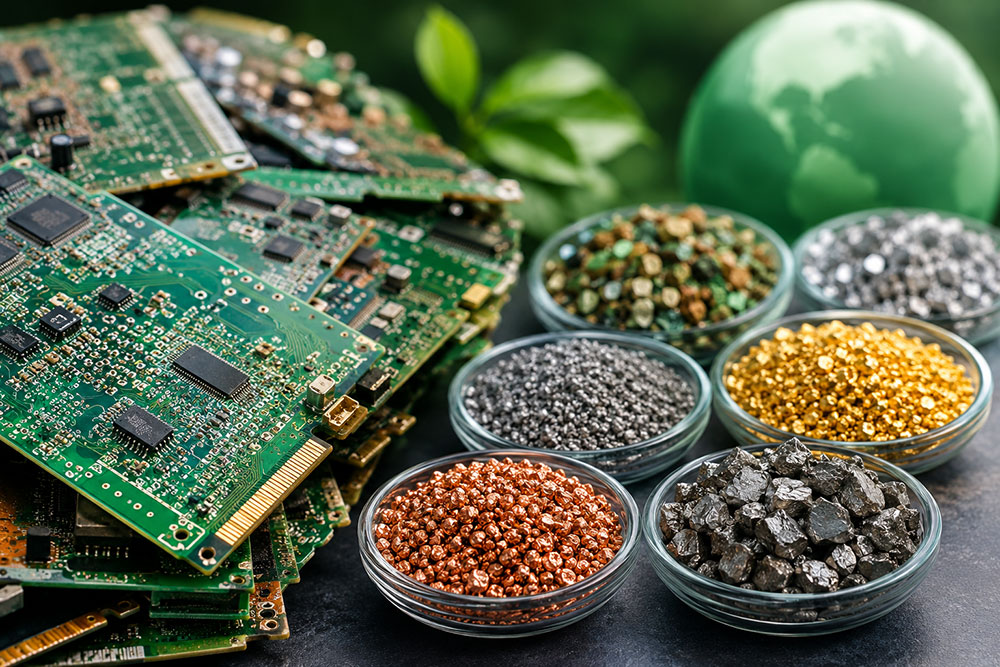
Copper is typically the primary recyclable metal found in PCBs.
For instance, if a batch of PCBs contains an average of approximately 15% copper, then theoretically:
1,000 kg × 15% ≈ 150 kg of copper
However, the actual recovered amount is influenced by factors such as impurities in the raw material, the degree of fragmentation, separation efficiency, and equipment recovery rates.
Therefore, a single fixed figure cannot simply be used to represent all PCBs.
In addition to copper, waste PCBs may also contain:
Although the content of precious metals like gold and silver is low, they are still worth recovering due to their high value.
💡It primarily depends on the following factors:
♻️The typical mechanical recycling process can be summarized as follows:
Through appropriate crushing and sorting, the metals in PCBs can be separated from non-metallic materials—such as resins and glass fibers—thereby improving resource utilization efficiency.
| PCB Type | Common Recyclable Resources | Recycling Characteristics |
|---|---|---|
| Computer Motherboards | Copper, tin, small amounts of precious metals | Relatively rich in metal resources |
| Mobile Phone PCBs | Copper, gold, silver, etc. | Small size, complex material composition |
| Home Appliance PCBs | Copper, tin, iron, etc. | Diverse sources of raw materials |
| Industrial Control Boards | Copper, tin, and other metals | Significant variation in material composition |
The amount of metal recoverable from a ton of PCBs ultimately depends on the actual analysis of the raw material.
Through scientific processes involving crushing, screening, and sorting, waste PCBs can be transformed from electronic waste into economically valuable recycled resources.
Gomine is dedicated to providing efficient waste PCB boards recycling solutions, helping clients achieve the resource recovery and utilization of waste circuit boards.


