
Leave Us a Message
Contact us now to get professional waste recycling solutions and quotation!


In the waste plastic recycling industry, the production capacity of washing and pelletizing lines has always been a major headache. In reality, output depends on far more than just the pelletizer itself; a bottleneck at any stage—from sorting, shredding, and washing to dewatering and pelletizing—can derail the entire process.
So, how can output be increased? The following five approaches are the most effective.
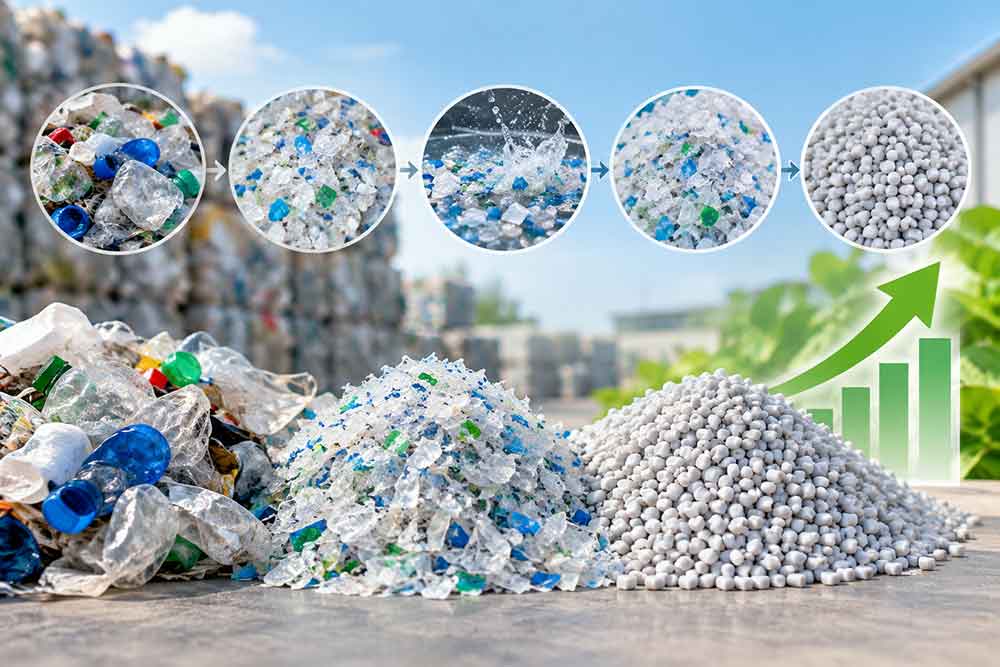
Raw materials are the first hurdle in ensuring the entire production line runs smoothly.
Handling materials varies completely depending on the type and level of contamination. If PP and PE are mixed together, or if hard contaminants like metal or stones are present, the equipment faces a heavy load, making it impossible to maintain the required operating speed.
Before the plastic enters the washing equipment, a preliminary sorting and impurity removal process can be carried out:
This ensures more consistent raw material quality, making it easier to maintain continuous operation during the subsequent stages of shredding, washing, and pelletizing.
The shredding step is crucial:
Therefore, the choice of shredder blades and screen size depends on the specific material you are processing. Getting the size just right ensures smooth operation during the subsequent washing and dewatering stages.
Impurities such as mud, sand, dust, oil, and labels on waste plastics vary, requiring different cleaning methods.
For example:
| Raw Material Condition | Key Treatment Measures |
|---|---|
| High silt/sand content | Enhance upstream impurity removal and washing |
| High label content | Intensify friction washing |
| Heavy oil contamination | Add targeted cleaning processes |
| General mild contamination | Standard water washing suffices |
So, boosting output isn’t just a matter of washing for a little longer. The key is matching the equipment to the specific characteristics of the material—ensuring it gets thoroughly cleaned while maintaining a high throughput.
After washing, plastic retains water; if it isn’t thoroughly dried before entering the pelletizer, not only does heating become slow and energy-intensive, but the machine’s operation also tends to become unstable.
Therefore, the dewatering stage is a critical part of the entire line where no corners can be cut.
The key to maximizing output is ensuring the entire line operates in a coordinated manner. If crushing is fast but washing lags behind, material piles up at the front; if washing is fast but pelletizing is slow, a bottleneck forms further down the line.
Therefore, when designing a waste plastic recycling production line, the following factors must be comprehensively considered:
A high-quality production line is not defined by the sheer power of a single machine, but rather by the stability and smooth, uninterrupted operation of the entire line.
Gomine specializes in eco-friendly recycling equipment. We provide comprehensive solutions—covering shredding, washing, dewatering, and pelletizing—tailored to your specific material type, contamination level, required throughput, and granule specifications, helping your operations run more reliably and efficiently.


